
Memory is a part of the human mind. It has the ability to retain information meanwhile learning is the process of gaining knowledge or skills through study, experience or teaching. It is a process that depends on experience.
There are various ways we can do to learn in order to improve our memory learning, such as:
- 5% lecture
- 10% Reading
- 20% Audio-visual
- 30% Demonstration
- 50% Discussion
- 75% Practice doing
- 90% Teaching others
Poor concentrations & How You Can Improve It
- Multitasking – Set a separate timer for when you can study and take breaks so you won’t multitask.
- Distractions – Put away devices when you are doing a task .
- Poor Reviews – Review and rephrase well with simple techniques such as highlighting, bullet points and summary.
- Messy workspace – Declutter your workspace and rearrange it for a better and more kept look for a study area.
- Diet – Stay with a fixed diet, bad diet can lead to poor concentrations.
The SQ3R Reading Method
Survey! Question! Read! Recite! Review!
- Before you read, Survey the chapter
- Question while you are surveying
- When you begin to Read, look for questions
- Recite after you’ve read a section
- Review: an ongoing process
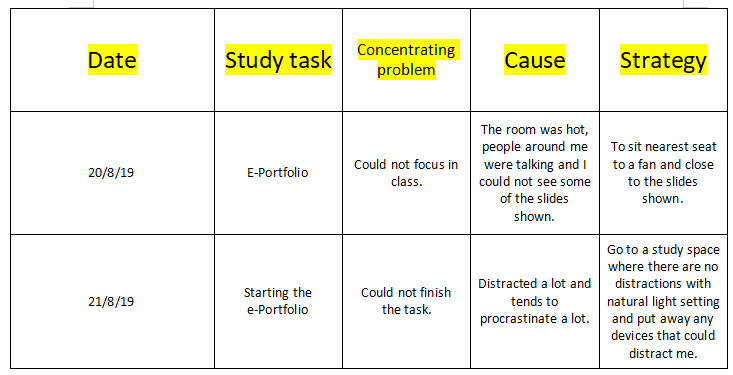
Activity 6: Strategies for improving concentration
In order for memories to maintain as long-term, strategies need to be made to make more interests in our studies, work, relationships and environment. It is also important to note that we should always recall, rephrase and summarize and what we want to remember or concentrate on the most. For example, classes, lectures, tutorials and quizzes.
Short-term memory & Long-term memory
Short-term memory is the space for holding, but not manipulating, a small amount of information in mind in an active, readily available state for a short period of time. Long-term memory refers to the unlimited capacity memory store that can store information over lengthy periods of time. By saying “lengthy periods of time” we mean that it is possible for memories in long-term memory to remain there for an entire lifetime.
 Adilah Sofiya's Blog